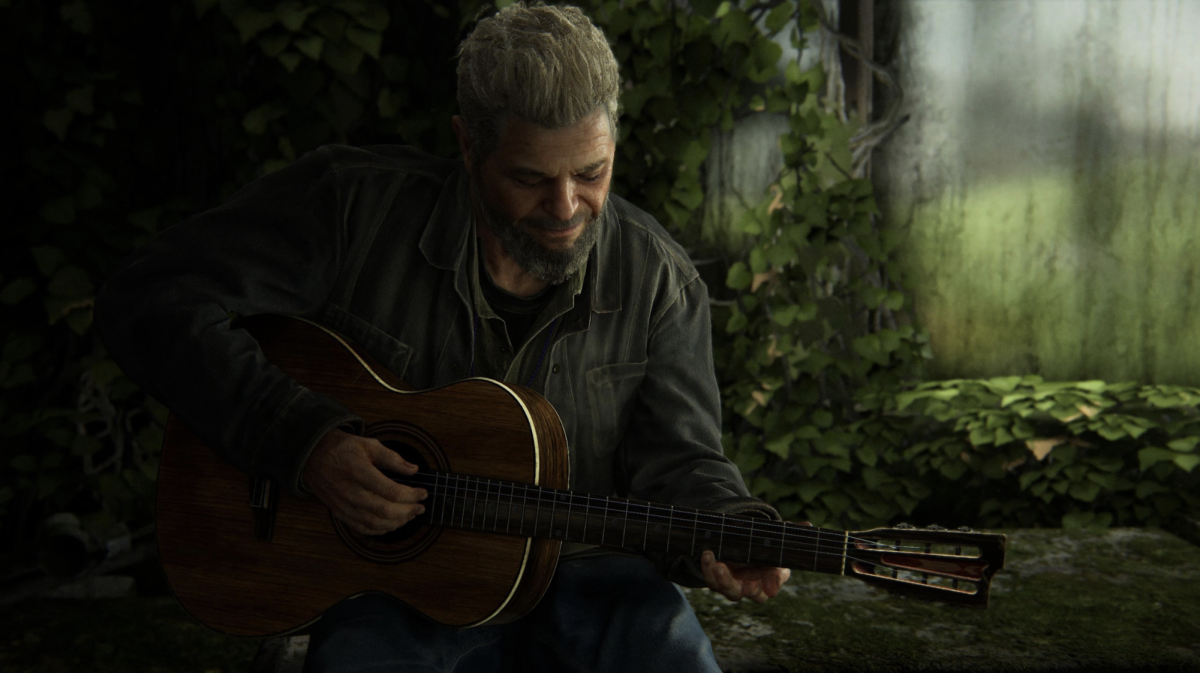
In music today, many often focus on a specific beat or swelling note, forgetting the storytelling power that silence can provide. In The Last of Us and The Last of Us Part II, silence is Gustavo Santaolalla’s main instrument in the soundtracks he created. It conveys emotions that couldn’t have been shown with any note other than nothing. He uses silence as a form of realism, conforming it to the themes of the games environment, as well as themes of the games plot. The contrast beyond the rests makes the experience of sound more impactful, as well as stripping the cinematic distance and making the player experience more intimate. When Santaolalla uses silence, he creates tension, and breaks it with sound.
For context, The Last of Us and The Last of Us II are video games released by Naughty Dog in 2013 and 2020, respectively. It reached such acclaim that it was adapted into an HBO Original series, starring Pedro Pascal and Bella Ramsey. In its universe, the world is a post-apocalyptic hellscape, where a fungal brain infection turns people into monsters. The first game follows Joel Miller and Ellie Williams on a journey across America to find a cure for the infection, and the second follows Williams on a revenge arc as she hunts her loved ones’ killer. Outside of the authoritarian quarantine zones, it’s a lawless land, with obstacles at every step and enemies on every corner. The minimalist soundtracks created by Santaolalla for the game have been described by Neil Druckmann, a creator of the game, as part of its “DNA.” To Druckmann, the music was so unique and intimate that it became a character of its own.
I. Emotional Realism
In creating soundtracks, many composers assign different styles of sounds to emotions. For sadder songs, you could often see slow tempos and descending melodies. For happy songs, you might see bright staccatos in a major key. However, some emotions are best left unheard. Emotions are complex things, and they aren’t easy to show. Everyone experiences emotions differently, so there isn’t a single answer as to how some emotions sound. In the world of The Last of Us, emotions like grief, trauma, and exhaustion are common feelings. However, these emotions aren’t felt loud, they’re felt silently, so the music must mirror how an emotion is felt. In the track titled “The Choice,” the silence between the sustained guitar notes highlights the themes of longing and morality experienced at points in the first game.
II. Environment
The environment that a composer must have in mind when creating their soundtrack is important. If it was a world full of life, you’d expect lively music, and if it was an unjust world, you’d expect darker music. The Last of Us is a desolate, broken, and empty world, where everything in it appears further away than one would think. How do you make sound for a world like this? Santaolalla found that the sound of being present in a broken world is often a lack of it. In nature, a person can be silent, but you still hear every chirp, every creak, and every gust of wind. In the track titled “All Gone,” the silence reflects the empty world, and the raw, broken up sounds are the few people left in it.
III. Plot
People would agree that in any emotional scene, in any movie or game, the music during that scene is critical. Imagine how terrible the sinking of the ship in Titanic would be if the song playing during it was “You Really Got Me” by the Kinks. When experiencing such emotion, it’s not always right to be feeling the sound of a swelling orchestra, it might be more appropriate to hear nothing. Think of any uncomfortable scene, then think of uncomfortable silence afterwards. When a character does something that’s seemingly unthinkable, the audience needs silence to think—an uncomfortable silence at that. When you see something you don’t like or don’t understand, it’s not right to have a soundtrack rescue you, but it is right for it to make you think deeper. Both games, the original and sequel, have many uncomfortable scenes. In the first game, the track “The Hour” mirrors discomfort with its haunting ronroco, while in the track titled “Unbroken” from the second game, with a delicate, atmospheric sound, has silence more attributable to reflection.
IV. Contrast
A buildup to important notes is common in all music. It’s the wait before the last belting keynote, the suspense before an iconic crescendo. In many soundtracks, you’ll see an orchestra build up to its most important note, but Santaollala doesn’t do this in his work. In his work with The Last of Us and The Last of Us Part II, he uses silence to build up to such notes. It acts as a veil, with the next note puncturing it, stronger than any from before. The effect on the listener is profound: it makes them wait in anticipation, as opposed to leading them to a feeling with a company of sound. In the track titled “Inextinguishable Flames,” the pensive sound pairs with the silence to create tension, using pauses that makes the listener pay close attention for what comes next.
V. Intimacy
The real world’s soundtrack is its ambiance, and the world’s silence is closely associated with this. In a fake world, too much outside of ambiance creates distance, the opposite of what storytellers want. When the silence is intertwined with the world, hearing nothing will pull the listener into it, making each moment personal and raw. In life, silence lets us hear unspoken emotion, using it in soundtracks makes it feel real. As Santaolalla says, it is an “eloquent silence. Not silence as in the absence of sound, but a contrary silence that can sometimes sound louder than the loudest note you can have with an instrument” (AP). To him, his work includes what is almost a “noisy” silence: an absence that’s so deliberate or stubborn it feels more impactful than if something else was in place of it. I believe this is one of the most notable parts of Santaolalla’s composing in these projects, and it’s easy to see in many of his tracks. Though, if I was to choose the best representations of the intimacy in his music, the tracks “The Last of Us (Goodnight),” “Longing (Redemptions),” and “The Way It Was” would likely be the most fitting. All of these have a different sound to them, though they typically share the quality of having slow paced, down-tuned sounds.
Of course, Santaolalla isn’t the first one to have used silence, and he won’t be the last. However, I think that his composing of the games is the most clear example of how it can be used effectively. The pauses reflect deeper meanings, they’re parallel to the story it helps tell. It stays beside the characters, and pulls the viewer in. It wouldn’t be effective if the story itself wasn’t as intense and emotional as it was. The Last of Us universe, even without its soundtrack, is a work of art. In this situation, the game and soundtrack lift each other up. The game makes the soundtrack iconic, just as the soundtrack makes the game memorable. 67




676767676767676767 • May 19, 2026 at 8:42 am
67676767
6767 • May 14, 2026 at 4:04 pm
67