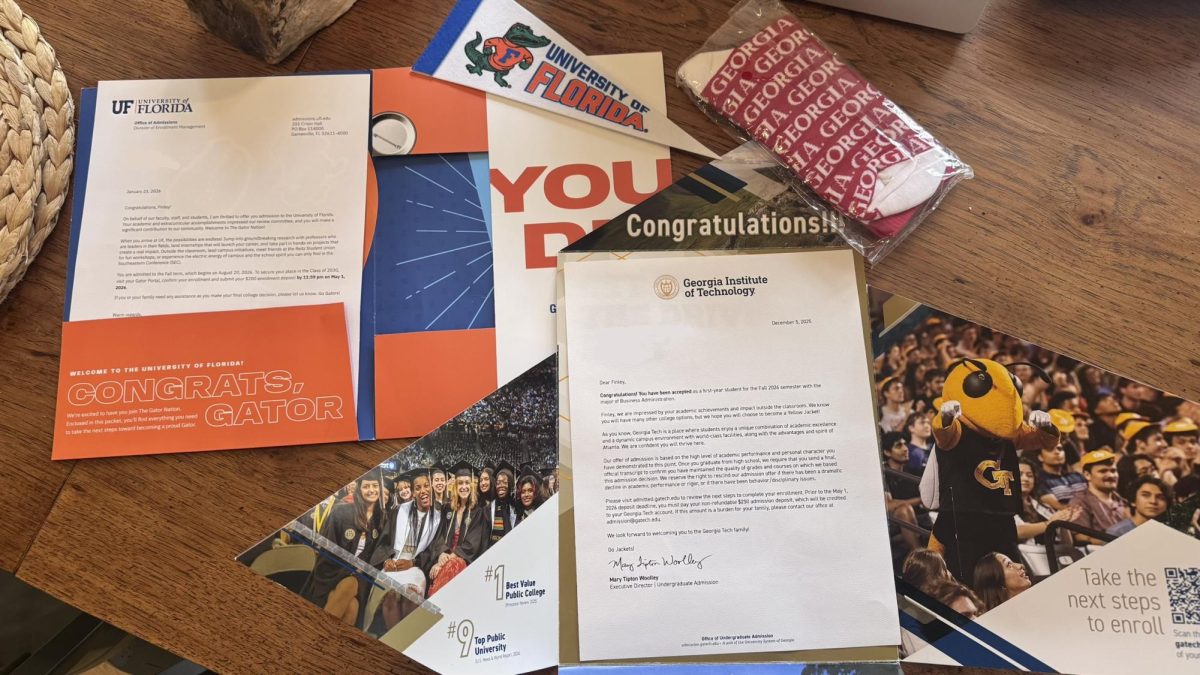
“What do you want to be when you grow up?” This question, for many, evokes emotions and memories; it’s a question that students are asked from kindergarten forward by curious friends, family, and teachers, and it’s one of the earliest questions many people can remember.
This question is often a common presence in young lives; because of this, many of those in high school have thought about future job plans quite a bit, and they may even have had some kind of career path in mind for years.
Planning how to get into a college that will lead to success, often takes a back burner until high school. It’s easy to say what you want to be when you’re six, but the reality of getting the necessary education is usually trickier, as many Chamblee High School seniors are well-aware.
“[Applying to colleges] was super overwhelming,” said Ella King (‘26). “I wrote over 20 essays with four to five drafts each. It was insane and intense, and it was, honestly, really awful.”
Other students share King’s experience of stress and overwhelm caused by the college application process.
“I would say that [college applications are] technically easy,” said Oliver Vega (‘26). “It’s just very stressful, and it’s very much bureaucratic in a sense. There’s a bunch of stuff that’s going on, and it’s really hard to keep track of it all.”
The process of applying to schools is made somewhat easier with CommonApp. CommonApp is a website that allows students to complete application requirements for a variety of colleges at once, and many seniors utilize this tool to streamline their quest for higher education.
“Most colleges use CommonApp,” said Vega. “Basically, you fill out a bunch of basic information on this college app board. You input stuff about where your parents went to school, whether they have been to college before, your ACT or SAT score, and all of the other basic information every college wants to know. After that, you can go to the college’s website for applications, and sometimes they want you to submit a little bit of extra stuff. For financial aid, you need to go through the colleges’ own websites.”
One of the most difficult and time-intensive parts of a college application for many students is writing all of the required essays.
“It’s harder than you think,” said Rashad Bijli (‘26). “The essay part was not difficult, but it takes more time than you think it’ll take you.”
Universities and colleges have the option of allowing students to apply to either regular decision, with results usually coming in March, early action, with results usually coming around December, or early decision, which is similar to early action, but with a binding contract. These early applications were due back in 2025, and have all been turned in. Most seniors who applied to college this way have gotten their results back, but that doesn’t necessarily mean the work is over for them.
“I know applications are still being sent out,” said Aspen Heimer (‘26). “I have to resubmit my FAFSA application twice because I forgot to add schools.”
Applying to college can be difficult, but many seniors see this difficulty as worth it to pursue what they’re really passionate about in life.
“I’m majoring in environmental engineering with an additional major called EDIE (engineering design, innovation, and entrepreneurship),” said King. “My end goal is to travel to developing communities and build water tanks for them, and bring clean water to people.”
There are absolutely things that some seniors would do differently if they had to go through this process again. A primary regret for many is procrastination.
“The first thing you want to do is start working on your essay soon,” said Jace Trotti (‘26). “If you’re a junior, start working on it this semester. When CommonApp opens on August 1st for the new season, go in and put all the boring demographic information because it will save you time.”
One of the many things that students recommend to get ahead on for college applications is their standardized test scores (like the SAT and ACT). Oftentimes, colleges post their median scores, so getting a head start on preparing can be helpful to exceed these averages.
“Don’t stress too much about ACT/SAT. Even if the analytics say something different,” said Vega, “just submit it, even if you don’t think it’s good enough. Unless it’s a 1200, and you’re trying to go to MIT.”
Sometimes, students are prompted to send scores as they take standardized tests throughout high school, despite typically sending the final score in senior year. Some students believe it’s important to wait until you are proud of your score to send it.
“I would absolutely not [send in a low score],” said Heimer. “Imagine you’re applying to Georgia Tech, you finally submit your application. In it, you say, ‘I’m a stellar student.’ Then, they receive your score, and it’s 1000. Embarrassing. And you know what happens if you score better in the future? They just think you were stupid for three years.”
Overall, before deciding where to apply and what to pursue, many students believe it’s important to consider what will bring fulfillment and joy in the future.
“Do whatever you’re passionate about,” said King. “Find your niche, find what you want to do, and go to the college that is best for you, not what other people are telling you.”