Students from elementary school through high school sometimes wish to spend class time outside, whether for educational purposes or for a change in scenery.
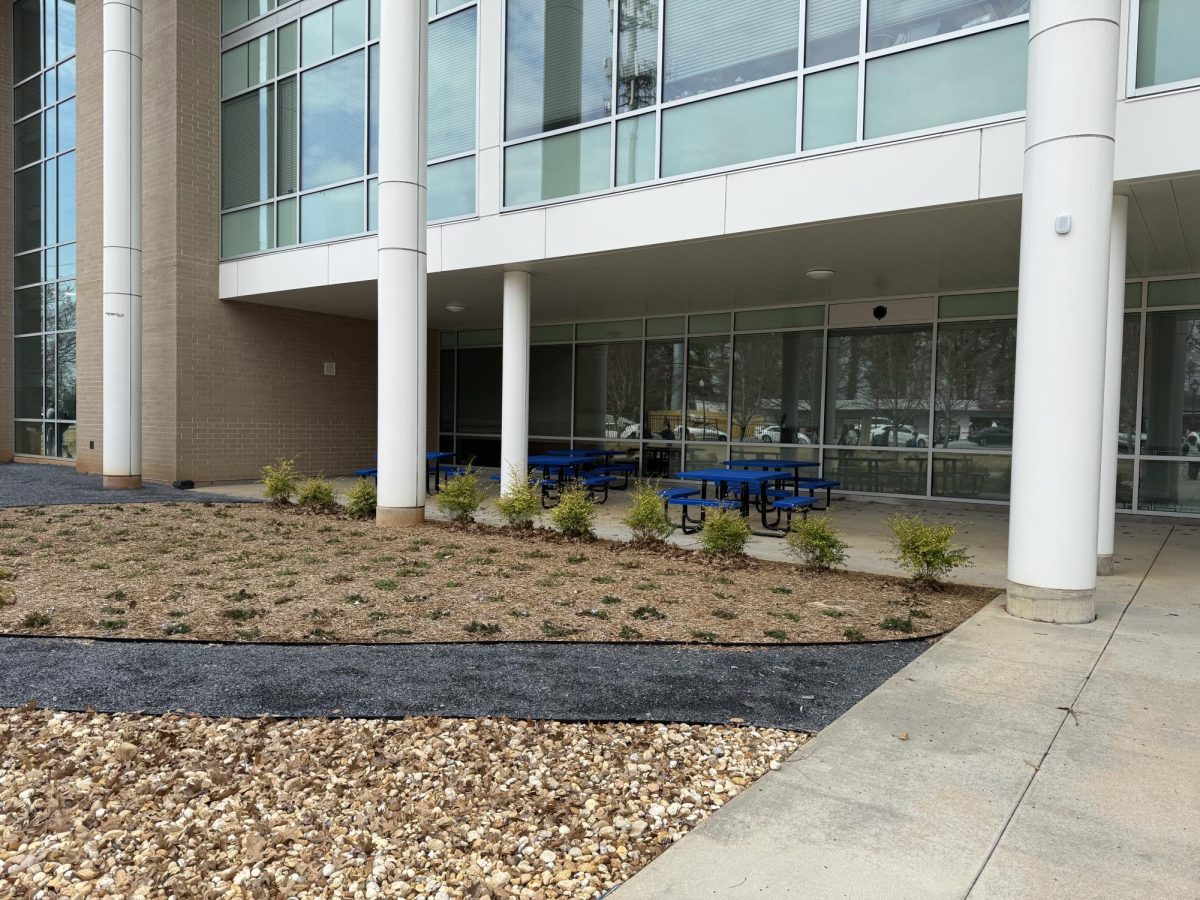
The Blue and Gold Foundation decided to make this possible last year when a new outdoor classroom was constructed in front of the school’s doors. With the addition of a new path and trees in front of the space, the area has become more appealing to students. While just a group of round blue tables, some students think the addition makes sense, as some have found practical uses for them over the past year.
“We used it during Ms. Shim’s final exam for freshman year…, and it gave us space to set our stuff down,” said Burke Fletcher (‘28).
The benefits of such outdoor classrooms have been well-documented by education nonprofits. According to an article from Green Schoolyards America, “Children who spend more time outdoors in nature, particularly at school, learn better. A direct relationship exists between nature exposure and cognitive skills, working memory, and attention. Direct and indirect nature exposure allows students to recover faster from mentally challenging exercises.” This supports the idea that even simple trips outdoors can help nurture students.
While just a group of round blue tables, some students think the addition makes sense, as some have found practical uses for them over the past year.
“We used it during Ms. Shim’s final exam for freshman year…, and it gave us space to set our stuff down,” said Fletcher.
As the school invests in transforming part of its grounds into an outdoor classroom, some see the changes as an opportunity to experience classes in a non-traditional setting.
“I think the school wants to keep moving students from inside the building to outside: closer to nature,” said Jackson Hudnall (’27).
The addition of the path shows the school’s commitment to the project and campus beautification.
“The updated path looks nice and can help students connect with nature. It’s less painful to get to the front of the building now, and I think it looks beautiful,” said Paul Budhram (‘27).
The connection to nature is also reported to influence the actions of students.
“The kids seem happy to be outside… they seem more lively, more engaged, they converse more, and work better together,” said Ms. Jennifer Shim.
Despite this, some question whether the gravel path, which came with the changes, could have a positive impact on students.
“I feel like it doesn’t add much, it’s just an easier way to the door, but you aren’t really moving around or having to go anywhere if you’re using the outdoor classroom, so it isn’t really necessary,” said Fletcher.
Outdoor classrooms have also been proven to help students improve skills unrelated to school. According to an article from the National Library of Medicine. “Educators spoke at length about how OL (outside learning) afforded students opportunities to practice and apply social and emotional skills. The development of social and emotional skills as a benefit of OL was evident…. As one educator summed it up: ‘So much social, emotional development happens in that time [spent in nature]’”. Because of this, some teachers combine the effects with utilizing the outdoor area as a motivator to encourage participation in class and complete assignments, making it valuable for both teachers and students.
“I use it as a reward,” said Ms. Shim. “If you work hard and you get your work done, we’ll go and have a class outside.”