On Saturday, January 24, 2025, a man climbed a skyscraper over 1,600 feet tall with no safety equipment. It might’ve sounded strange, and it might’ve sounded unbelievable, but by no means was it impossible. As a live event on Netflix, this was one of the first times people could see such an impressive feat the moment it happened. I’ve climbed for years, but even I struggled to have any feelings other than fear watching it, and all I had to do to feel that way was to watch it happen while lying in my bed with a bowl of chili and a glass of water.
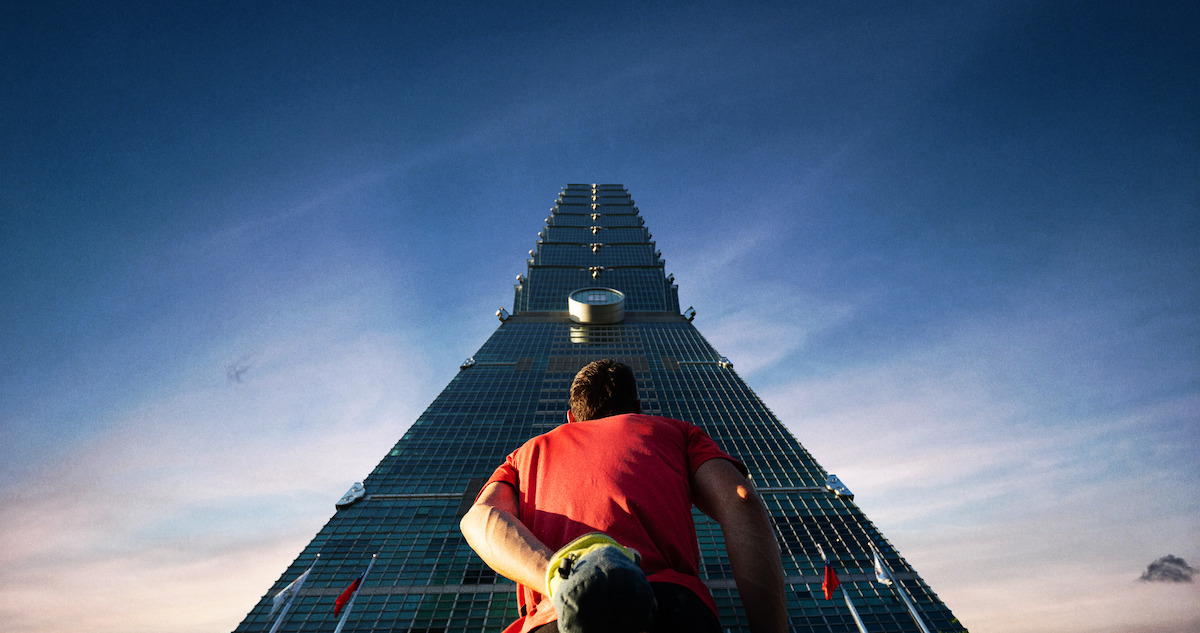
People might ask, “Who would do such a thing?” The most famous free soloist, and arguably the most famous rock climber of all time, Alex Honnold – that’s who. Most would know him from the award winning documentary Free Solo, which followed his journey climbing Yosemite’s El Capitan with no protection. Nearly eight years later, he decided to tackle Taipei 101, a nearly 1,700 foot tall skyscraper in Taiwan.
The building has a variety of features he needed to tackle, though definitely not as much as typical rock. Most of the moves stay consistent, smearing his feet against glass and pulling his hips further above them. Towards the end of each of the eight identical “bamboo box” sections, the longest part of the climb, he had to switch techniques to tackle the “dragon,” an awkwardly shaped feature on the corners of the boxes that he had to get on the side of and mantle above. After that, the most challenging part of the climb was around 1,400 feet up, the steepest part of the climb, the overhangs. In this part of the climb, viewers witnessed Honnold hanging with his body over a ledge, legs dangling, all after over 75 minutes of climbing. Towards the end, Honnold climbed the spire. After 101 floors, he climbed a janky ladder swaying in the wind up a featureless spire, then stood on top of the world, and took a selfie.
Regardless of his confidence, it was scary watching him on the overhangs after the commentators and everyone was silent, hearing him all of a sudden say, “You know what? I’m kind of tired.” Of course, I didn’t feel so bad after him admitting he was tired long before that, because Honnold as well as the commentators had pretty much said, “Well of course he’s tired, look at how big the building is!” But it was moments like these that kept everyone on their toes. One such moment was during the 52nd minute, which started after Honnold had finished another hard section he began to say, “My comms went out, and I can’t hear my music anymore.” I was stuck between thinking if I was watching history unfold or a tragedy unfold.
Despite all this, however, I feel like the human aspect of watching someone do something so dangerous is a feeling everyone has to feel at some point. I’ve known who Alex Honnold was for almost eight years now, and in many circles of climbers, he’s talked about like some myth or legend, almost as if he’s beyond human. He’s become so well known that climbers joke about the “have you seen Free Solo” question as if you asked a person, “Is the sky blue?” Climbers try to understand how impressive he is, but it’s hard for even a climber to compare themselves to him when the difference between them is like an eight year old child’s and Michael Phelps’s ability to swim.
I think what made the livestream so entertaining is the fact that when people first watched Free Solo, they knew he survived, because how else would the documentary have been made? But when people watch a live event, they don’t know what could happen, and while confident he’ll perform well, you can’t be 100% sure he’d be alive 10 minutes later. You don’t know if the 40 year old husband and father of two will ever see his family again. I think that might be what made it so exhilarating to watch, realizing that it’s not a movie, and that there might not be a happy ending.
The commentators announced early on, within maybe 90 seconds of him starting, that he would die if he fell, yet he still had well over an hour to go. From the 90th second, I was glued to the screen and I didn’t look away: it was more captivating than most movies I’ve watched. I think that in recent history, this sort of media is becoming less and less common to see, so I’m happy to see proof that it’s not completely gone.