
From March 15th to April 6th, March Madness takes hold of the country’s basketball fans, but it doesn’t just start at the tip off. The National Collegiate Athletic Association runs the March Madness tournament with both women and men’s college basketball athletes partaking in the series of games. According to the NCAA, “The NCAA Division I men’s basketball tournament is a single-elimination tournament of 68 teams that compete in seven rounds for the national championship.” This championship takes place during the month of March, leading to the use of the term “March Madness,” which was popularized by Brent Musburger when he used the term during his coverage of the 1982 tournament. Since there are so many teams in this tournament, there is a wide variety of school sizes.
“[Watching] small D1 programs play against these big schools and upset them [makes the tournament exciting],” said Grayson Baker (‘29).
Along with watching these games, people also make brackets for who they believe will win the games. This interactive portion of the tournament drives creativity, since each person has a different way of formulating their bracket. Eleanor Head (‘28) varies her bracket depending on her preferences of the lower and higher ranked teams that season.
“When in doubt, I usually go with the higher-seeded team, but if I want the underdog to win, I might pick the underdog,” said Head.
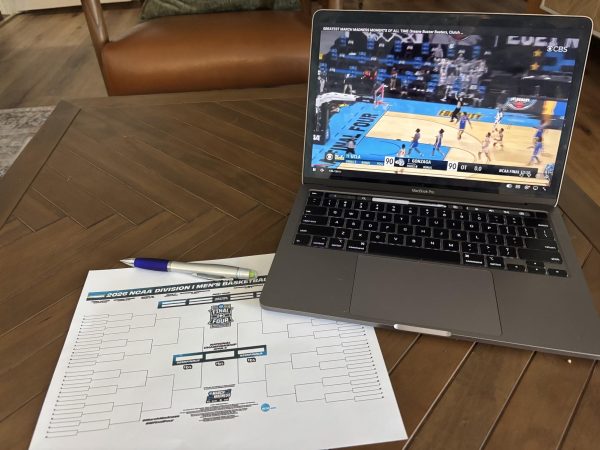
Others have a set formula they use to ensure a perfect bracket.
“Michigan goes pretty far every time [on my bracket]. I’ll have one or two Cinderella stories and a few upsets in the first and second rounds,” said Javier Valanju (‘29).
According to NCAA, “A Cinderella team is one that is much more successful than expected.” Not only do people place unlikely teams in their brackets, but these stories also add to the entertainment value of the entire tournament.
“The Cinderella stories, small teams, upsets, and the fans [make March Madness different from a normal basketball tournament],” said Baker.
Band director, Mr. Preston Ridgell, finds that the uncertainty of the games makes this tournament in particular spectacular.
“When you have those ‘sleeper’ teams that no one ever considers making a run, [and they end up] doing some damage, I think that’s what really makes it exciting. It’s a one and done competition, and you [have to] bring your ‘A’ game; sometimes players don’t do that,” said Mr. Ridgell.
For Head, once the first few games have concluded, the excitement begins to ramp up.
“There are a few games at the beginning that are very skewed [towards] one [team], but once the Sweet 16, Elite Eight, and Final Four [begin, they’re more] intense games that are really fun to watch,” said Head.
As of now, the teams for March Madness have not been released, but ESPN is tracking all the men’s teams that are on track to qualify for the 2026 tournament. Once these teams come out, you can submit your bracket to the The Bracket Challenge Game hosted by the NCAA and Capital One; however, no one has ever gotten a perfect bracket before. Once the 68 qualifying teams are released on March 15th, the creation of brackets begins!