
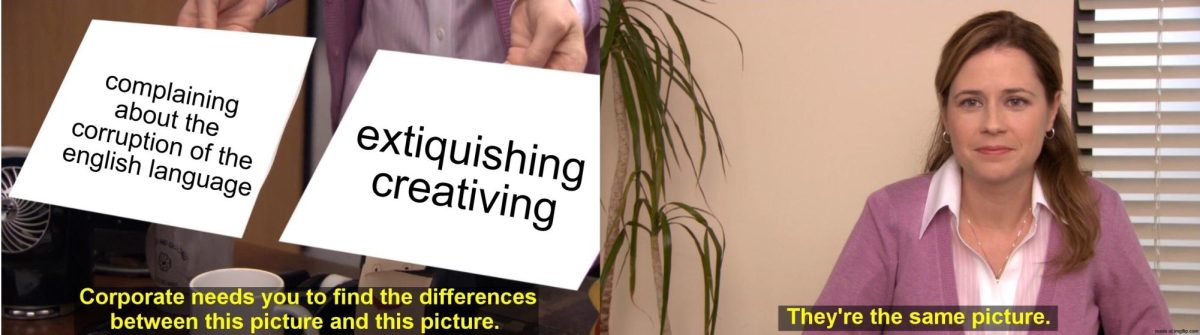
Season 8, episode 2 of the hit 2000s sitcom The Office opens with the idiotic yet beloved Kevin refusing to speak in complete, grammatically correct sentences. After drawing his colleagues’ attention with his odd and confusing behavior in the workplace, he is called to talk to the manager, Andy. Andy and Kevin’s coworkers, Pam and Jim, attempt to convince Kevin that his new manner of speaking borders on unintelligible, and Kevin counters with the provocative and well-known quote, “Why waste time say lot word when few word do trick?” (The Office Wiki).
While Kevin’s bit is only meant to be an amusing and comical beginning to the episode, his question may still hold merit: why should we still bother with expansive vocabularies, eloquence and diction?
We see evidence of the quickening pace of life all around us; from drive-thrus at every corner to TikToks plaguing our youths’ attention spans to our planet literally spinning faster, it seems that we no longer have the time—or capacity—to relish in the art of language.
As a journalist, I often feel the need to condense my writing into digestible articles that grab readers’ attention and hold it for the few minutes I can eke out, which means my articles often lack the creativity and poetry of language that I value. When I let my personal writing style meld with the prescribed format of a Blue & Gold feature, I am asked why I write such long articles, why I choose “big” words, and if my voice appeals to readers.
Indeed, the article format and traditional writing conventions are the norm for a reason—they deliver to readers information clearly and appropriately, which is often what people are looking for in their news articles. But monotonous reporting does not turn a one-time reader into a continuous subscriber, nor does it promote continued literacy and authorial development in readers and student journalists alike.
That is not to say that journalists who choose to follow the standard conventions are “bad writers” or that their work is uninteresting. All types of writing have a place. But rather, a writer should not feel too constrained by the conventions to the point where they sacrifice the integrity of their writing style. A journalist must adhere to the principles of truth, accountability, transparency, and fairness, but these tenets do not preclude creativity.
I love language. Language is an organism that lives and breathes and evolves with us. Language is the key to humanity’s success (for better or worse) in cultivating a world for ourselves. Therefore, I take it upon myself to use language. To use language that has been lost to time, overwritten by new culture, or that has simply been obscured due to its rare applicability. Having a rich vocabulary fulfills me; crafting a perfect sentence satisfies me.
I also love reading about others’ perspectives on the language that I hold so dear. In 1946, George Orwell published his essay, “Politics and the English Language,” a critique of writers who he believed contributed to the detriment and degradation of our language. Orwell calls out the writing of his time as too loquacious or too uninspired, pretentious or unintelligent, but between his valid concerns about convolution and redundancies, he falls into the cliche of “old man yells at cloud”: an older generation ranting about the colloquialisms and practices of the new. The rules he insists upon might be helpful to beginning writers who are unsure of their voice and style, but they ultimately stifle one’s creativity and prohibit a love for language that I so greatly benefited from.
When discussing the idea that “the decline of a language must ultimately have political and economic causes,” as Orwell put it in his essay, it is also important to note the role that racism and prejudice have in inciting the belief. While Orwell’s essay does not touch on this factor, certain dialects of English, such as African American Vernacular English (AAVE) and Southern American English, as well as non-native speakers with noticeable accents, tend to be viewed as unintelligent (Smithsonian Magazine). While dialects such as AAVE have developed their own grammar and pronunciation rules that distinguish them from simple slang or broken English, many English speakers tend to see AAVE in a negative light (National Institute of Health). Often, it is the perceived prevalence of AAVE in popular culture that disturbs some English speakers who are apoplectic at the thought of “their” language being tainted by what they believe to be an inferior culture due to deeply ingrained racism.
He who attempts to save the English language from corruption is the true tyrant, for in his fight to clarify and purify, he instead extinguishes. Though I personally tend to gravitate towards verbosity when my writing impassions me, I am not worried by styles that seem comparatively simpler. Because all styles have merit, and because it is not my place to tell a fellow writer what to write or how to write.
Words are there for a reason. Use them. Or don’t. It is your own choice to make.