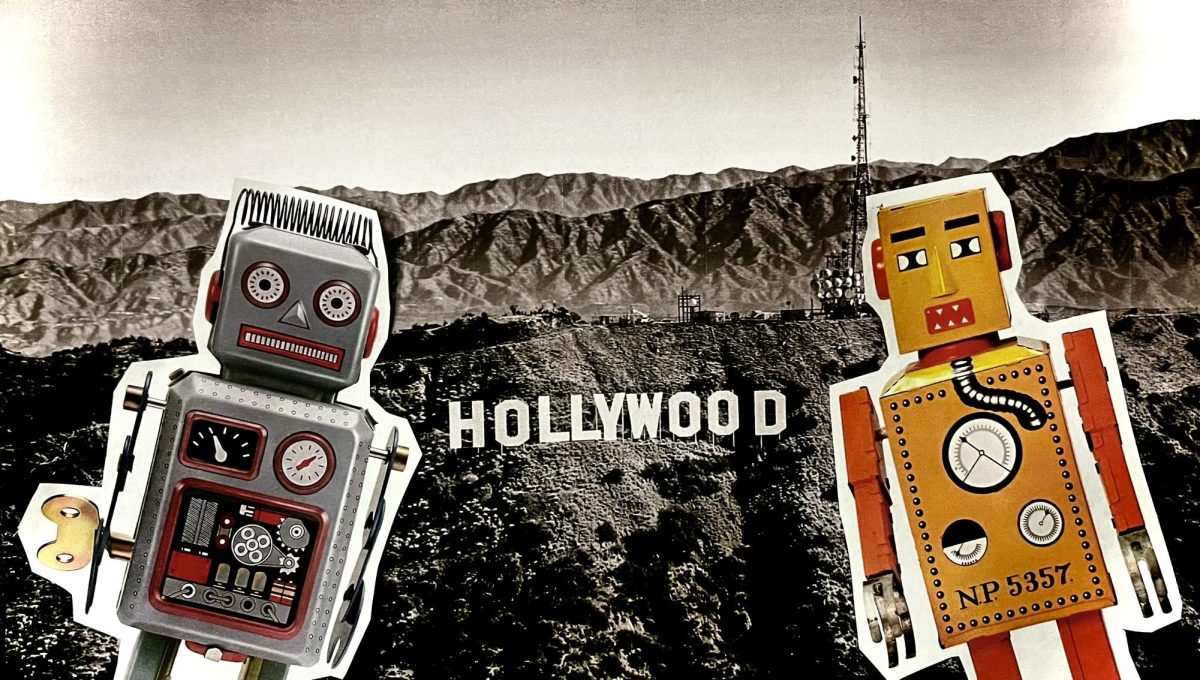
As the prominence of artificial intelligence (AI) began to rise, society started to speculate on the fields in which it could be applied the most. AI was expected to make significant changes to spheres such as engineering, mathematics, and medicine. However, the one industry that it has seemed to affect the most significantly is the one that few predicted: entertainment. Art, like film and television, has always been perceived as uniquely human, so it came as a shock to many that AI could have such an influence on it. Yet, the biggest mark AI has left on society so far has been through art, primarily through image and video generation on social media. As this technology has become increasingly more advanced and accessible, the film industry has been impacted by AI in unprecedented ways, from the emergence of AI “actors” to visual effects, to the theory of fully AI movies. AI could serve as an effective tool for filmmakers, but it also holds the capability to destroy the film industry forever. How has AI affected Hollywood so far, and what does it hold for the future?
AI Actors
While movie magic can create fake sets, props, and effects, audiences understand that there is always one thing on screen that is undeniably real: the actors. In a world built full of prosthetics and CGI, a human performance is the key driver of making a film’s illusion work. Even in fully animated movies or animated characters such as Thanos or Gollum, there is still a human performance behind every character. However, with the rise of artificial intelligence, this might not be the case for much longer. Meet Tilly Norwood, a computer-generated “actress” currently being pitched by Xicoia Studios as a replacement for human actors. It’s easy to say that society will never embrace a performance by an AI actress, but recent trends in media suggest otherwise. Social media websites are littered with AI models and influencers followed by millions of internet users. If people are ready to accept AI performers on Instagram and TikTok, it’s only a matter of time before they’re ready to accept them in film.
It’s no surprise that studios find the idea of AI actors appealing. For one, they never age. Having a bankable star means a lot to a studio, and if that “actor” stayed the same age forever, studios would never even need to take a chance on new talent. Another appeal about AI actors is that they’re predictable. Real actors get into controversies or disputes that can derail entire franchises, but that isn’t an issue if the actor has no personality. And obviously, the most enticing part about AI actors is that they never need to be paid.
It sounds far-fetched, but studios have already started implementing AI actors into their work. A recent trend is AI extras. Extras are brought onto set for one day, have their faces and bodies digitally scanned, are paid once, and then their likenesses are used in projects forever. This issue was a central reason for the Screen Actors Guild strike in 2023.
This is scary enough, but if AI actors such as Tilly Norwood were given real roles in productions, it would be devastating to the industry. Obviously, AI actors eliminate the human element of acting. AIs are unable to make unique character choices or try new things. They are only able to deliver lines exactly the way they are in the script, meaning they don’t and never will have nearly as much nuance as a human performance, and audiences will be able to tell. AI actors also take away one of the most important and underappreciated parts of acting: improvisation. It sounds like a trivial loss, but it’s significantly more important than audiences realize. Many of the most important moments in film history (“Here’s Johnny!”, “You’re gonna need a bigger boat”, “I am Iron Man”, and countless others) were improvised by actors. A machine doesn’t have impulses that can lead to moments like these; they can only follow exact instructions, eliminating the magic that comes from improvisation on set.
Visual Effects
Speaking realistically, when it comes to all the moving parts of the film industry, the ones most likely to be affected are in post-production: visual effects, animation, etc. That doesn’t mean all animators and VFX artists will lose their jobs, but it’s realistic to expect the production pipeline to be thinned out. AI should be given responsibility for handling the more mundane aspects of VFX, such as lighting, texturing, and modeling.
Many people will see this as a morality issue, as artists could be put out of work, but this is just the evolution of the industry, and history has and will continue to repeat itself. Similar outcries occurred in the 1990s with the rise of computer-generated imagery (CGI). People criticized it, claiming it was lazy and artificial, advocating for practical effects instead. Today, CGI has become a fundamental part of filmmaking, and many films and stories could not be told without it. It’s also important to note that artificial intelligence in visual effects is not entirely new. The Lord of the Rings trilogy used a primitive AI engine that enabled 3D doubles of humans in a large-scale fight scene to emulate the human mind’s thought process, creating layers and variation in the crowd’s movement. While this is technically considered algorithmic AI rather than machine-learning AI like ChatGPT, the result is largely the same.
Now, AI has become far more advanced, and the reality is that technology cannot be uninvented. If filmmakers can use AI as an efficient resource for VFX, they are going to, and shouldn’t be criticized for it, as long as they are filling gaps rather than replacing them. AI will be especially enticing for independent filmmakers, as it will allow them to attain visual effects that would otherwise be too expensive.
Even for high-budget projects where the cost of CGI isn’t as much of a hindrance, AI still has its uses. A perfect example of how AI should be used in the industry is Ben Affleck’s company Interpositive, which Netflix recently acquired. Instead of using AI to generate new content, it enhances the filmmaker’s content. It can relight scenes, remove stunt wires, and, most importantly, generate believable pickup shots, minor shots from different angles that filmmakers might have missed, which will provide a cost and time-saving way to avoid reshoots.
However, using AI for visual effects is a slippery slope. While it has proven to be a powerful assistant in certain cases, such as with Interpositive, it should be nothing more than that. It should serve as a tool and be used extremely sparingly. If filmmakers start abusing AI to take shortcuts in their VFX or to make their VFX entirely AI-driven, then they become no different from the “AI Slop” that pollutes social media, and audiences will notice.
Fully AI Movies
Overall, a common trope that has recently become more prominent in discussions of AI in film is the idea of fully AI-generated movies. Many people believe that AI will soon become so advanced that an everyday person could type a short 1-2-sentence prompt into their TV and, in seconds, have a fully fledged movie generated from it. People who debate this idea fear that it will soon become the norm for film and television.
How far is this idea from reality? Visually, AI is still pretty distant from being indistinguishable from human art, at least for someone well-versed in digital media. However, it is improving at an alarming rate, getting exponentially more believable and realistic by the day, making this technology only a few decades, at most, away from a world where it will truly be impossible to tell, visually, what is and isn’t AI. However, that does not mean that AI will be able to produce movies on par with human filmmaking.
A clip of Tobey Maguire as Spider-Man fighting Chris Evans as Captain America recently went viral. Aside from a few major tells and the intentionally low video quality to hide the AI’s blemishes, the clip looked scarily realistic and likely fooled tens of thousands of casual internet users. But the key thing to remember is that AI didn’t just create this clip on its own. It wouldn’t exist without the algorithm being fed Sam Raimi’s Spider-Man trilogy and Evans’ Captain America movies, which is why the clip is essentially a substandard impression of the cinematography and tone of these two franchises. AI is an echo chamber that can only mimic pre-existing media and will always reproduce lower-quality content than the original. So, visually, an AI movie could match a real film in believability, but it will never come close to matching it in creativity.
It’s this simple concept that proves why AI will never be able to create a movie nearly as good as a human: AI is incapable of having an idea. Everything it creates is derived from human-made media fed into its algorithm. AI will never do anything that hasn’t been done before, or that is unique and defies stereotypes, because it needs something to base its generations on. Additionally, AI will never create art. Art is, by definition, a physical expression of human emotion and experience. While an AI can certainly create something that resembles art, it cannot create true art.
Does It Even Matter To Audiences?
So while it’s been established that a human-made film will forever reign superior over an AI-generated one, there are still many more questions than answers about AI in the film industry. The most pressing one, and the most threatening towards almost all jobs in Hollywood: Does the difference in quality of AI versus human films even matter to audiences?
AI has become so normalized to Gen Z and Gen Alpha, to the point where it isn’t seen as unethical or uncreative, and has just become synonymous with internet content in general. These generations are the future of movie audiences, and their behavior and attitudes towards AI-generated films will significantly influence the industry. If they do not care about the lack of originality in AI-generated short-form content on social media, then there is no guarantee that this mindset will not transfer to long-form content as well. And if studios don’t see any opposition from the new generation of audiences to fully AI films, it provides them with yet another incentive to make them a reality.
In fact, studios have already started incorporating fully AI content into users’ consumption. In late 2025, Disney CEO Bob Iger announced his plan to use OpenAI to allow Disney+ users to create and post content featuring Disney IP characters on the platform. While this deal was recently terminated after OpenAI shut down the Sora app to prioritize other AI tools, Disney representatives claimed in a Variety article that they “will still continue to engage with AI platforms”, indicating that Disney’s ambitions to feed users fully AI content are far from over.
If fully AI projects becoming the norm wasn’t a significant risk before, having them fed to consumers by one of the biggest media giants will certainly make it one. Disney’s plans are a step closer to the increasingly more likely idea of all long-form media being uniquely AI-generated for viewers through prompts. Such a reality would put every writer, actor, and producer out of work, and would mark a transition into a world where original ideas are a thing of the past, and all media is merely an artificial mimicry of content from a better time. Additionally, if everyone consumed individual AI-generated films that are uniquely prompted by them, the shared cultural experience and events that movies brought to society would disappear. Creativity would simply become obsolete, and it seems like the younger generations don’t even find this alarming.
Again, when speculating on the future of the industry, there will always be infinitely more questions than answers. How far away is Hollywood from AI actors? From fully AI films? And when they come, will society accept them? Is Hollywood racing towards a future where human-made films are a forgotten, niche part of the industry, like vinyl records or vintage cars? There are ethical and useful ways to embrace AI in film production, but is that enough for filmmakers, or will their greed and laziness drive the industry towards a terrifying future? And even more terrifying, will audiences even care?